The normal property ladder has 35 exceptions
Across 1,509 outcodes with at least 50 five-year sales of flats, terraces, semi-detached and detached homes, the median flat costs 34.2% less than the median terrace. Flats were cheaper in 1,472 outcodes, equal after rounding in two, and more expensive in just 35.
The exceptions are not small rounding errors. In PL28, the five-year median flat price was £740,000 against £330,000 for a terrace. In BB9 it was £134,950 against £79,995; in LL65, £190,000 against £119,000.
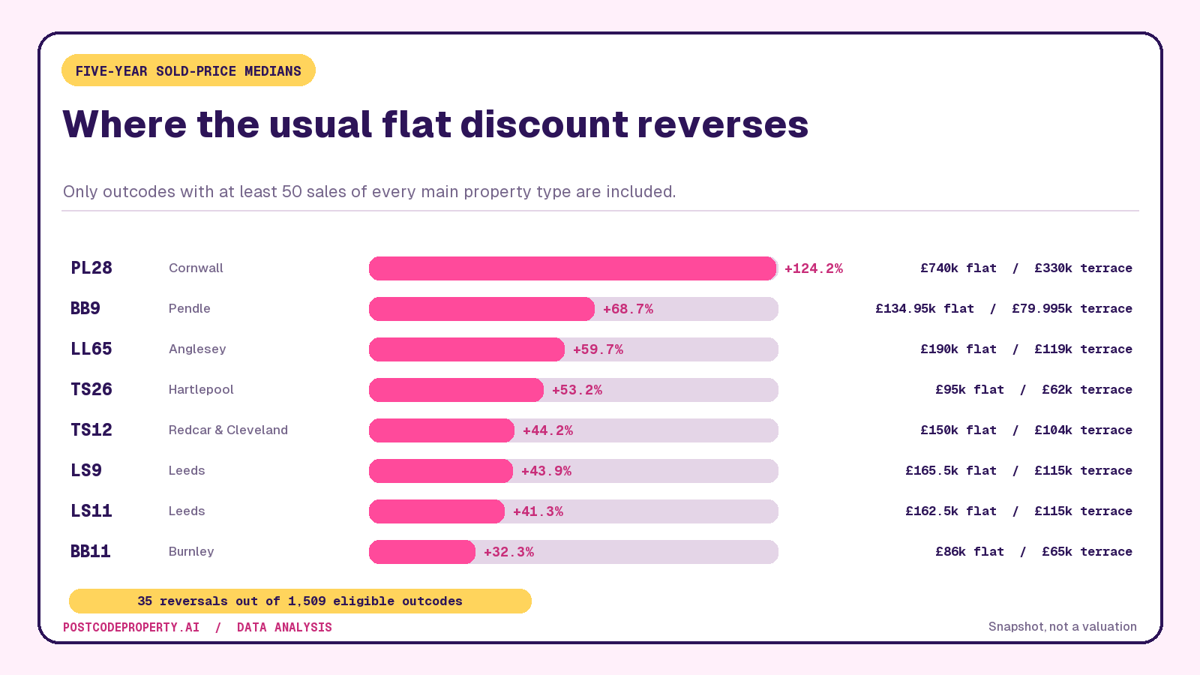
The largest reversals
These are medians for everything sold in each type, not the price difference between two otherwise identical homes. That is precisely why the reversals are useful: they reveal outcodes where the flat market and terrace market occupy different locations or buyer niches.
PL28: a coastal mix-shift in one number
PL28 covers the Padstow area. Its £740,000 flat median does not mean a generic flat is worth more than the same home with its own front door. It indicates that flats sold in the period were disproportionately drawn from a premium coastal and second-home market, while the terrace sample includes a broader range of stock.
The outcode had enough volume to clear our 50-sale-per-type rule, but its four-type sample was still only 397 transactions. A specialist development or a handful of high-value schemes can move a median more in PL28 than in a large city outcode.
The correct reading is: property type is entangled with micro-location and product. “Flat” can mean a new waterfront apartment with parking and a view; “terrace” can mean older inland stock. The category labels do not create a like-for-like comparison.
The northern pattern is different
BB9, TS26, LS9, LS11 and BB11 are not Padstow. Their reversal is often driven by very low terrace medians alongside a flat market concentrated in newer, central or converted developments.
Consider TS26: flats at £95,000 and terraces at £62,000, while the semi-detached median is £158,000 and detached median £275,000. The terrace is the cheapest rung in that local mix. In BB11, the four medians are £86,000 for flats, £65,000 for terraces, £160,000 for semis and £280,000 for detached homes.
For a first-time buyer, this can make the traditional “start with a flat” rule actively unhelpful. A terrace may offer more space and freehold tenure for less upfront money—but it may also carry higher heating, maintenance and renovation costs.
Why the reversal happens
Several mechanisms can produce a flat premium at outcode level:
The same logic explains why a national property-type average should never be applied directly to a specific address.
What to compare before choosing the cheaper terrace
Purchase price is only the first line of the calculation.
A £65,000 terrace can still be the more expensive five-year decision if it needs £40,000 of work. A £95,000 flat can be worse if a large service-charge bill or short lease sits behind the asking price.
Methodology
HMLR records completed prices but not floor area, condition, lease terms or exact comparability. The analysis is descriptive and should not be read as a valuation model.
Open a property-type page such as terraces in LS9 or flats in PL28, then check the individual address with the full property search.