The short answer
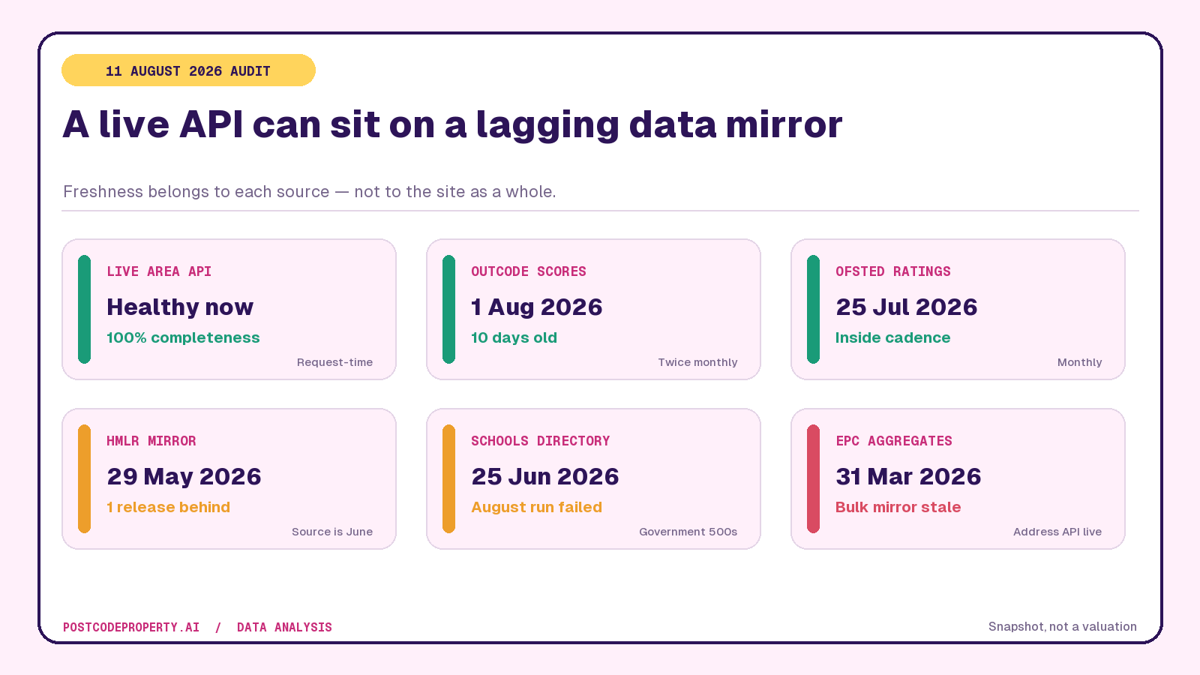
The live PostcodeProperty.ai service is operating normally, but “live” does not mean every underlying dataset was published today. On 11 August 2026, the production health endpoint reported both application and data databases healthy. The paid area API returned HTTP 200 with 100% source completeness, and the latest national canary completed 138 passes, zero failures, 20 transient warnings and 64 legitimate skips.
The stored mirrors tell a more mixed story. Outcode rankings, Ofsted ratings, transport stops and care-provider data are inside their expected refresh windows. The HM Land Registry mirror is one monthly release behind the publisher. The aggregate EPC mirror ends on 31 March, although individual-property EPC lookups use the live API. The schools directory also missed its 5 August refresh after the government export host repeatedly returned HTTP 500.
What we tested
We checked freshness at three different layers, because each answers a different question:
That distinction matters. A database can be online while serving old records; equally, a bulk mirror can lag while a property-level lookup still gets a current answer from an upstream API.
The source-by-source result
The official HM Land Registry Price Paid page was updated on 28 July with June transactions. Our mirror tops out on 29 May, so the honest label is one release behind, not “fully current.” Land Registry also warns that the newest month is incomplete and is revised in later releases, which is why a few weeks of publication lag do not make long-run analysis invalid.
The EPC split is different. The official bulk EPC service now sits behind GOV.UK One Login, which prevents the old unattended national download job from running in CI. Property pages therefore read a specific address from the live developer API, while rankings and national aggregates use the last bulk mirror. Those are two different freshness states and should be labelled separately.
What the green canary does — and does not — prove
The 10 August canary made 222 assertions. The zero-failure result is strong evidence that the main report sections are populated and internally plausible across the country. It checked, among other things:
Twenty warnings came from request-time amenity, crime or transport blocks timing out on individual probes. They did not contain a wrong value; the block was explicitly absent, which is safer than silently substituting zero. Persistent collapse is covered by the database-wide checks.
This does not prove that every source record is correct. Government data can be revised, address matching is imperfect, and area-level facts should never be treated as a survey of a specific building. It proves that the platform is responding, the main sources are present, and known staleness is visible rather than hidden.
Three monitoring alerts need interpretation
The upstream availability job currently flags three non-200 test URLs: DEFRA UK-AIR, the Food Standards Agency and HM Land Registry linked data. Those alerts are real, but they indicate that the probe URLs have moved or reject a bare health request; they do not by themselves prove that a customer report is missing all three sources. The full-pipeline canary is the stronger product test.
This is why a single green tick is not enough for a multi-source data product. Good monitoring needs both cheap endpoint probes and realistic end-to-end requests, with source vintage reported alongside availability.
Our conclusion
As of 11 August 2026:
That is the standard we use in the four analyses that follow this post: the snapshot date, sample rule and source limits are stated next to every chart.
Sources and method
Run a free area report to see the source availability for a postcode, or read how we calculate the investment score before using any ranking.